Commercial · Toronto
Master Key System Design
A dental office wants the front desk to lock up at night without ever holding a key to the room where patient records and controlled supplies are stored. Right now one master key opens both, which nobody is comfortable with once it is pointed out.
Master Key System Design
In plain words
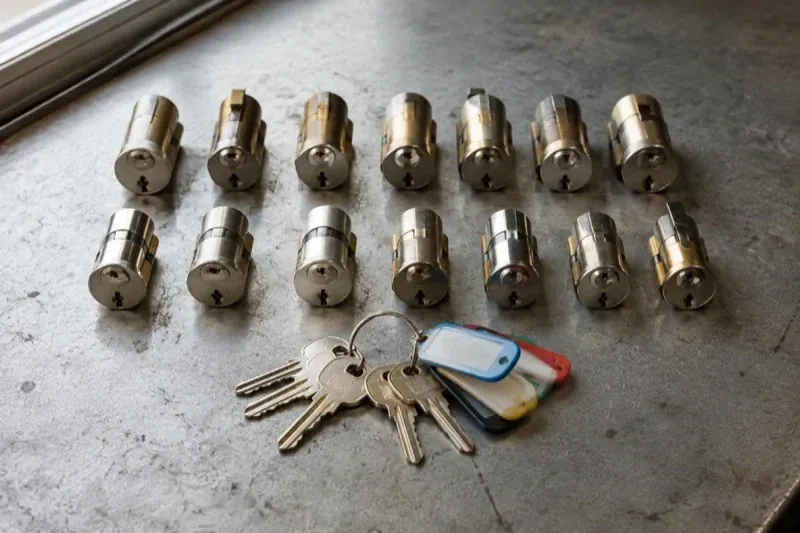
Beyond convenience, master key system design is a security decision. It sets out who can duplicate a key, how many levels of access exist, and what scope the chart assigns to a lost key at each level, from one door up to the whole property for a top master. A restricted or patented keyway is often part of the answer, since it cuts down on copies being made anywhere other than through the record the owner controls. The result is a system where access matches role, duplication is tracked, and every missing key's designed scope is already known rather than guessed at afterward.
How the visit goesA property manager taking over a small commercial building inherits a shoebox of keys with no labels and no chart. Some open the mechanical room, some open vacant units, and a few do not seem to match anything currently on the property at all.
Toronto
How the visit goes
Who needs to open what
Before any hardware is chosen, the locksmith records the organization's actual shape: which roles, departments or shifts need access to which doors, including exceptions such as a bookkeeper who needs the records room but not the loading dock. This map is built with the owner or manager, not guessed from existing keys, since existing keys often reflect years of ad hoc copying rather than any real plan. The output is a plain list of who should open what, which becomes the target the rest of the design is measured against, well before a single cylinder is touched or a key is cut.
Building the hierarchy from the bottom up
Design starts with the smallest unit, the individual change key, and works upward. Each door that stands alone gets its own combination; doors that should share access are grouped under a sub-master; and a single top-level master is reserved for the short list agreed earlier. Building in this order keeps the levels honest, since a sub-master or master is only created where a real group of doors justifies it, rather than being added because it seems useful in the abstract. The result is a hierarchy that matches the organization rather than one imposed on top of it.
Knowing exactly what a lost key affects
If a key goes missing later, the chart tells the business precisely which doors that level can reach, rather than leaving anyone guessing whether the whole property needs attention. That scope can then be compared against how the key was likely lost and who else already holds that same level, so the response, whether rekeying one group, one door, or leaving it recorded and monitored, is a decision made with real information.
Master Key System Design
In the van
- Bench test fixture
- Key cutting machine
- Cylinder decoders
- Restricted or standard key blanks
- Master pin kits
What affects the quote
Same fees day, night or weekend
1Testing scope before handover
Testing every cylinder individually and then testing each master and sub-master across its full group takes time proportional to how many doors and levels exist. A larger hierarchy with more levels to verify against more doors adds to that testing time.
2Any optional upgrade chosen along the way
Some businesses use the project as an opportunity to also upgrade a door closer, add a keypad to one entry, or reinforce a strike plate. None of this is required for the master key system itself, and each optional item is quoted as its own line.
3Electronic locks alongside mechanical keys
Where keypad or card doors need to line up with the mechanical hierarchy, the quote includes the extra coordination of matching access levels across both systems and pinning any mechanical override cylinders into the same chart as the rest of the property.
Master Key System Design: questions
What is tested before the keys are handed over?
Every cylinder is tested on the bench against its assigned keys, then again once installed: the change key on its own door, the relevant sub-master across its whole group, and the top-level master across every door in the system. Any lock that responds to a key it should not is corrected before handover rather than left for the owner to discover later.
What is a restricted keyway and do I need one?
A restricted or patented keyway limits who can cut a copy of your keys to whoever holds the manufacturer's authorization record, rather than any hardware counter. It suits doors behind which cash, records or controlled supplies sit. A standard keyway is simpler to administer and works well for lower-risk doors where duplication control matters less.
Who should hold the top-level master key?
As few people as the business can genuinely operate with. Every additional holder is another way a full-access key can be lost, borrowed or copied without anyone deciding that should happen. A useful test during design is asking, for each proposed holder, whether they need to open every single door on the property or only a defined group; the second answer usually points to a sub-master instead.
Commercial Locks
- Access Control InstallationThe back door of the shop runs on one key, and by now it lives on six different rings: yours, two…
- Panic & Exit HardwareThe new access-control reader at the staff entrance works fine going in, but nobody has sorted out…
- Commercial-Grade Lock ReplacementA new tenant moved into the unit next door, and the property manager just found three different…
Master Key System Design near you
Every lock service we provide in Toronto starts with the same first step, which is looking at the door properly before deciding anything. The individual pages below explain what that look involves for each job, how the work is carried out, and what to expect from the hardware afterwards.