Commercial · Rouge Hill
Master Key System Design in Rouge Hill
A dental office wants the front desk to lock up at night without ever holding a key to the room where patient records and controlled supplies are stored. Right now one master key opens both, which nobody is comfortable with once it is pointed out.
Master Key System Design
In plain words
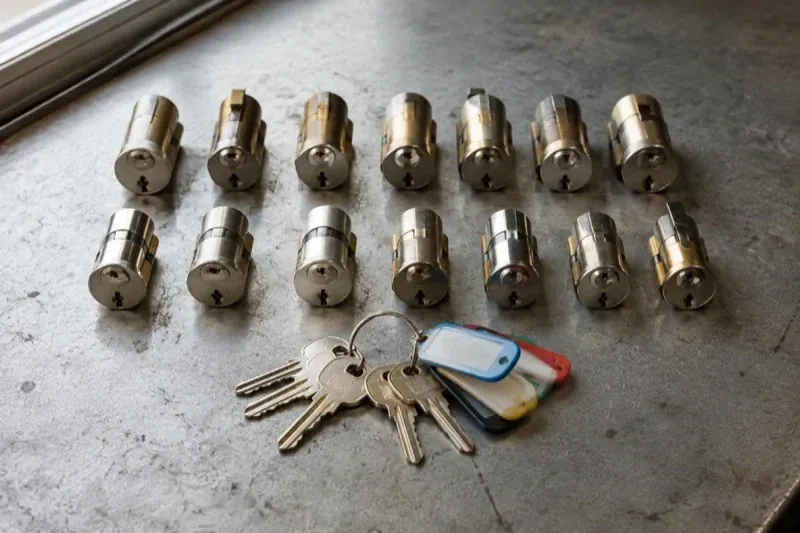
What a business actually takes away from a master key system project is a documented chart, not just a set of new keys. Every level is recorded against the doors it opens, every key is marked by role rather than by address, and the cylinders have been tested individually and as a group before handover. That record becomes the reference for everything that follows: adding a new employee, handling a departure, or working out exactly what is affected if one key later goes missing, instead of guessing from a label on a keyring.
How the visit goesA property manager taking over a small commercial building inherits a shoebox of keys with no labels and no chart. Some open the mechanical room, some open vacant units, and a few do not seem to match anything currently on the property at all.
Rouge Hill
How the visit goes
Where a sub-master genuinely earns its place
Not every group of doors needs its own level. The assessment looks for places where a sub-master is a real convenience, such as a department, a floor, or a set of storage rooms used by the same small team, rather than adding levels for their own sake. A hierarchy with more levels than the business actually uses is harder to manage and easier to get wrong later, so this stage is as much about deciding what not to build as it is about what to include, before any pins are cut or any key blanks are ordered.
Building the hierarchy from the bottom up
Design starts with the smallest unit, the individual change key, and works upward. Each door that stands alone gets its own combination; doors that should share access are grouped under a sub-master; and a single top-level master is reserved for the short list agreed earlier. Building in this order keeps the levels honest, since a sub-master or master is only created where a real group of doors justifies it, rather than being added because it seems useful in the abstract. The result is a hierarchy that matches the organization rather than one imposed on top of it.
Handing the record to whoever administers it next
The chart, the issuance log and any spare keys are handed to a named administrator, not left as loose paperwork or scattered across whoever happened to be present. If that role changes hands, custody of the record moves with it deliberately, along with a signed acknowledgement of what is being transferred, so the system's history does not quietly disappear along with the person who used to manage it.
Master Key System Design
In the van
- Bench test fixture
- Key cutting machine
- Cylinder decoders
- Restricted or standard key blanks
- Master pin kits
What affects the quote
Same fees day, night or weekend
1Compatibility of existing hardware
Cylinders that can join the new hierarchy without modification keep the project smaller. Hardware that is mismatched, worn or built on an incompatible keyway needs replacing to fit cleanly into the plan, and that replacement hardware is a separate line from the design and pinning work.
2Room reserved for future growth
Building spare capacity into the keying platform so a business can add doors later without a full redesign takes deliberate planning during the design stage. A property with clear expansion plans may choose a platform with more reserved combinations, priced differently from a minimal, current-needs-only design.
3How many locations are involved
A single building is simpler to assess and pin than several sites intended to share related levels of access. Travel between locations, and keeping the hierarchy consistent across more than one property, both add to the overall scope of the project.
Master Key System Design: questions
What is tested before the keys are handed over?
Every cylinder is tested on the bench against its assigned keys, then again once installed: the change key on its own door, the relevant sub-master across its whole group, and the top-level master across every door in the system. Any lock that responds to a key it should not is corrected before handover rather than left for the owner to discover later.
What is a restricted keyway and do I need one?
A restricted or patented keyway limits who can cut a copy of your keys to whoever holds the manufacturer's authorization record, rather than any hardware counter. It suits doors behind which cash, records or controlled supplies sit. A standard keyway is simpler to administer and works well for lower-risk doors where duplication control matters less.
Who should hold the top-level master key?
As few people as the business can genuinely operate with. Every additional holder is another way a full-access key can be lost, borrowed or copied without anyone deciding that should happen. A useful test during design is asking, for each proposed holder, whether they need to open every single door on the property or only a defined group; the second answer usually points to a sub-master instead.
Commercial Locks
- Access Control InstallationThe back door of the shop runs on one key, and by now it lives on six different rings: yours, two…
- Panic & Exit HardwareThe new access-control reader at the staff entrance works fine going in, but nobody has sorted out…
- Commercial-Grade Lock ReplacementA new tenant moved into the unit next door, and the property manager just found three different…
Master Key System Design near you
The lock services offered in Rouge Hill are grouped the way a door is used. Getting back in when you are locked out. Deciding who holds a working key. Upgrading the hardware so the door resists more than a casual try. Keeping commercial entrances working. Opening and maintaining safes. Each is described below.