Lockouts · Rouge Hill
Lost Keys — Same-Visit Rekey in Rouge Hill
You let a part-time employee go on Friday. The shop key is on a ring in their apartment, or their car, or a friend's kitchen, and on Monday morning the register and the stock room open with it.
Lost Keys — Same-Visit Rekey
In plain words
If you rent, losing a key is handled in three steps rather than one. Tell your landlord first, since a lock change on a rented unit goes smoother when both sides know about it and both end up with a working key. Then the locksmith rekeys the suite door, and any other cylinder that key fitted, with both parties knowing. Finally new keys are cut for you and for the landlord's set, so the arrangement that existed before the loss is restored on a fresh combination. Landlords generally welcome the call; their hardware stays in place and their own key set is refreshed too.
How the visit goesThe renovation wrapped up in the spring. The crew was good, the kitchen looks right, and the key you handed the foreman on day one was never handed back. Nobody kept track of who on the crew carried it.
Rouge Hill
How the visit goes
Which cylinders the key actually opened
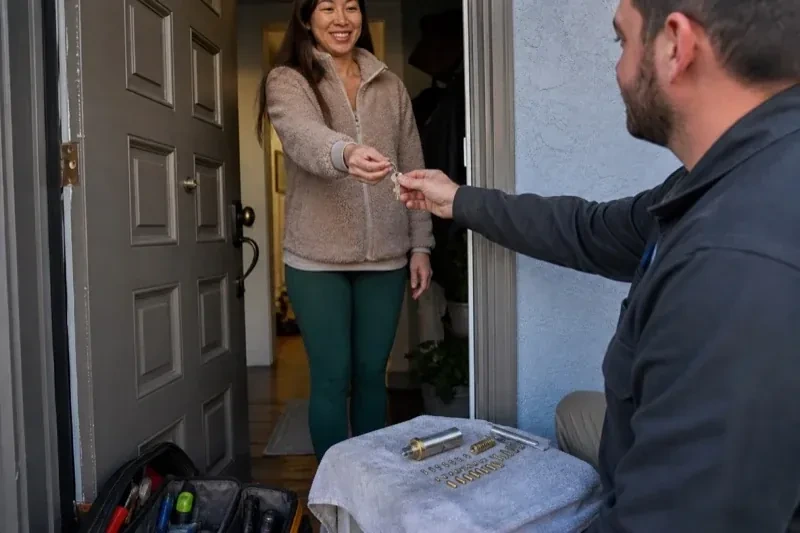
The locksmith walks the property with you and tries to think like the key. Front door deadbolt and handle, the back door, a side door, the door between the garage and the house, the shed, a gate padlock, a basement walkout, the door to a storage room or workshop. Each cylinder the missing key fitted goes on a list. Anything it fitted that is not yours to change goes on a second list: a shared lobby door, a parking gate, a community mailbox compartment, a workplace. The first list becomes the scope of the visit; the second becomes a set of calls you can make with the locksmith's help while the work goes on.
Handling a restricted or high-security keyway
Restricted and patented keyways rekey in much the same way, with more parts and a little more care. A high-security cylinder's own elements, a sidebar's finger pins, a rotating element or another system-specific part, are reset to the new key's profile alongside the ordinary pins, and the finished plug is checked before refitting. Key blanks for these systems are issued through whatever authorised channel that system uses, a letter, a registered account, a dealer agreement, or sometimes a key card; bring whatever credential you were given. The reward is that copies of the new key can only be made through that same channel, one of the stronger kinds of key control a household can have.
Cylinders that turn more sweetly than before
A cylinder that has been apart, cleaned and repinned usually feels better than it did before the key went missing. Old grease, road salt and the grit that collects in a keyway over a decade came out with the plug, and a dry lubricant went in. Keys cut to code seat fully and lift each pin cleanly. If a door had a key that needed a wiggle or a shove, that is often gone. Follow your lock's own maintenance guidance to keep it that way: many cylinders take a puff of graphite or PTFE into the keyway now and then, some a specified liquid lubricant instead; general household oils and sprays collect dust and gum the pins.
Lost Keys — Same-Visit Rekey
In the van
- Rekeying pin kit
- Plug follower set
- Top pins and cylinder springs
- Cylinder retaining-clip and cap tools
- Dry graphite or PTFE lubricant
What affects the quote
Same fees day, night or weekend
1Condition of the cylinders
A clean, healthy cylinder is repinned as is. One clogged with salt and grit is cleaned first, and a worn or damaged one is replaced rather than repinned, each priced as its own item.
2Upgrades chosen during the visit
Some people take the moment to move to a heavier deadbolt, a restricted keyway, a reinforced strike or a lockbox for the spare. None of it is required; each option is a separate line.
3Homeowner-rekeyable cylinders without a working key
Resetting a homeowner-rekeyable cylinder when its key is gone uses that system's own reset fixture, where the installed lock supports one, and a few extra minutes per cylinder, which shows as a small line on the quote.
Lost Keys — Same-Visit Rekey: questions
Should I rekey when I move into a new home?
Lock manufacturers list moving as one of the main reasons to rekey, and it is easy to see why: previous owners, their relatives, a cleaner, a dog walker and a contractor may all hold copies you know nothing about. Rekeying every exterior cylinder in one visit resets the count to the keys in your hand, and it is a convenient moment to put every door on a single key as well.
Does rekeying weaken the lock?
No. On a conventional pin-tumbler cylinder, the housing, springs and top pins are untouched and only the bottom pins are exchanged for the same grade of part the lock left the factory with; a homeowner-rekeyable design is reset through its own procedure instead, and a high-security cylinder may also need its sidebar or finger-pin elements reset. If the locksmith notices worn parts, replacing them is offered as a separate step, leaving the lock stronger, not weaker.
What about the mailbox key?
It depends on whose mailbox it is. A private box at your door or on your post is yours, and its small cylinder can be rekeyed or replaced in the same visit. A compartment in a community mailbox or an apartment mailroom belongs to the postal service or the building, which handles lost-key lock changes through its own process. The locksmith will tell you which you have and who to call.
Lockout Services
- Business Lockout ServiceYou signed the lease on the unit last week and the landlord handed over possession, but the…
- Broken Key ExtractionThe key went in like any other morning, you turned it, and something gave with a small metallic…
- Break-In Damage Lock RepairThe back door looks closed until you touch it.
Lost Keys — Same-Visit Rekey near you
The lock services offered in Rouge Hill are grouped the way a door is used. Getting back in when you are locked out. Deciding who holds a working key. Upgrading the hardware so the door resists more than a casual try. Keeping commercial entrances working. Opening and maintaining safes. Each is described below.